How Pegasus Works
Pegasus operates through a multi-stage attack chain: delivery (zero-click or one-click), exploitation (triggering a vulnerability in the target's device), installation (deploying the spyware payload), and persistence (maintaining access). Understanding each stage is essential for forensic detection and defense.
- 01Pegasus uses a multi-stage chain: delivery → exploitation → installation → persistence → exfiltration
- 02Zero-click delivery exploits automatic message parsing — no user interaction required
- 03The exploit chain typically combines a memory corruption bug with a privilege escalation (kernel) exploit
- 04Pegasus can operate in a 'stealth' mode that self-destructs to avoid forensic detection
- 05Persistence varies by platform — iOS infections are often non-persistent; Android variants can survive reboots
The Attack Chain
Pegasus infections follow a structured multi-stage process. Each stage represents a potential detection or defense point.
Stage 1: Delivery
Delivery is how the exploit reaches the target device. There are two primary modes:
| Mode | User Action | Vector Examples | Stealth Level |
|---|---|---|---|
| Zero-click | None | iMessage, WhatsApp call, SMS attachment | Maximum — no visible trace |
| One-click | Tap a link | SMS with link, email link, web exploit | Moderate — link may be visible |
In a zero-click attack, the exploit is embedded in a specially crafted message. When the target's phone receives the message, the operating system automatically parses and renders its content — this is where the vulnerability lives. The exploit fires during this automatic processing, before the user ever sees the message. The message is then silently deleted. The target has no indication anything happened.
Stage 2: Exploitation
Once the exploit is delivered, it must trigger a vulnerability in the target software. Pegasus exploits typically target:
- Media parsing libraries: Image decoders (JPEG, GIF, TIFF), PDF parsers, font rendering engines, and audio/video codecs — these process incoming content automatically and are common sources of memory corruption bugs
- Messaging frameworks: iMessage's BlastDoor service, WhatsApp's call setup protocol, SMS processing — these handle untrusted input from the network
- WebKit/Safari: Browser-based exploits delivered via malicious web pages (one-click)
- System frameworks: PassKit, HomeKit, and other system services that process data automatically
The exploit typically triggers a memory corruption vulnerability — a heap overflow, use-after-free, or type confusion — that allows the attacker to redirect program execution to shellcode they control.
Stage 3: Privilege Escalation
After the initial exploit runs within the context of the messaging app or media parser, it typically does not have full system access. A second exploit — a kernel-level privilege escalation — is used to gain root/system privileges. This allows Pegasus to install itself deeply, access all data on the device, and hide its presence.
Kernel exploits are the most closely guarded secrets in the spyware world. They allow an attacker to escape the application sandbox and gain full control of the operating system. Apple and Google patch these vulnerabilities as soon as they are discovered, but zero-day kernel exploits (unknown to the vendor) can remain exploitable for months or years.
Stage 4: Installation & Payload
Once the attacker has root privileges, the Pegasus payload is deployed. On iOS, this is typically a dynamic library or Mach-O binary that is injected into a running process or loaded into memory. On Android, it may be an APK installed alongside a legitimate app or a system-level service.
The payload establishes a command-and-control (C2) channel — an encrypted connection to NSO Group's infrastructure (or the operator's infrastructure) — through which the operator sends commands and receives exfiltrated data.
Stage 5: Persistence
Persistence determines whether the spyware survives a device reboot. This varies by platform and configuration:
| Platform | Persistence Type | Survives Reboot | Detection Difficulty |
|---|---|---|---|
| iOS (non-persistent) | In-memory only | No — cleared on reboot | Harder — minimal traces |
| iOS (persistent) | Filesystem implant | Yes | Easier — files on disk |
| Android (persistent) | System APK/service | Yes | Easier — visible in app list (sometimes) |
Non-persistent iOS infections are harder to detect because they leave minimal forensic traces — the spyware exists only in RAM and disappears when the device reboots. However, this also means the operator must re-infect the device after each reboot, which increases the chance of detection through network traffic analysis.
Stage 6: Exfiltration
Once installed, Pegasus begins exfiltrating data to the operator's C2 servers. This includes:
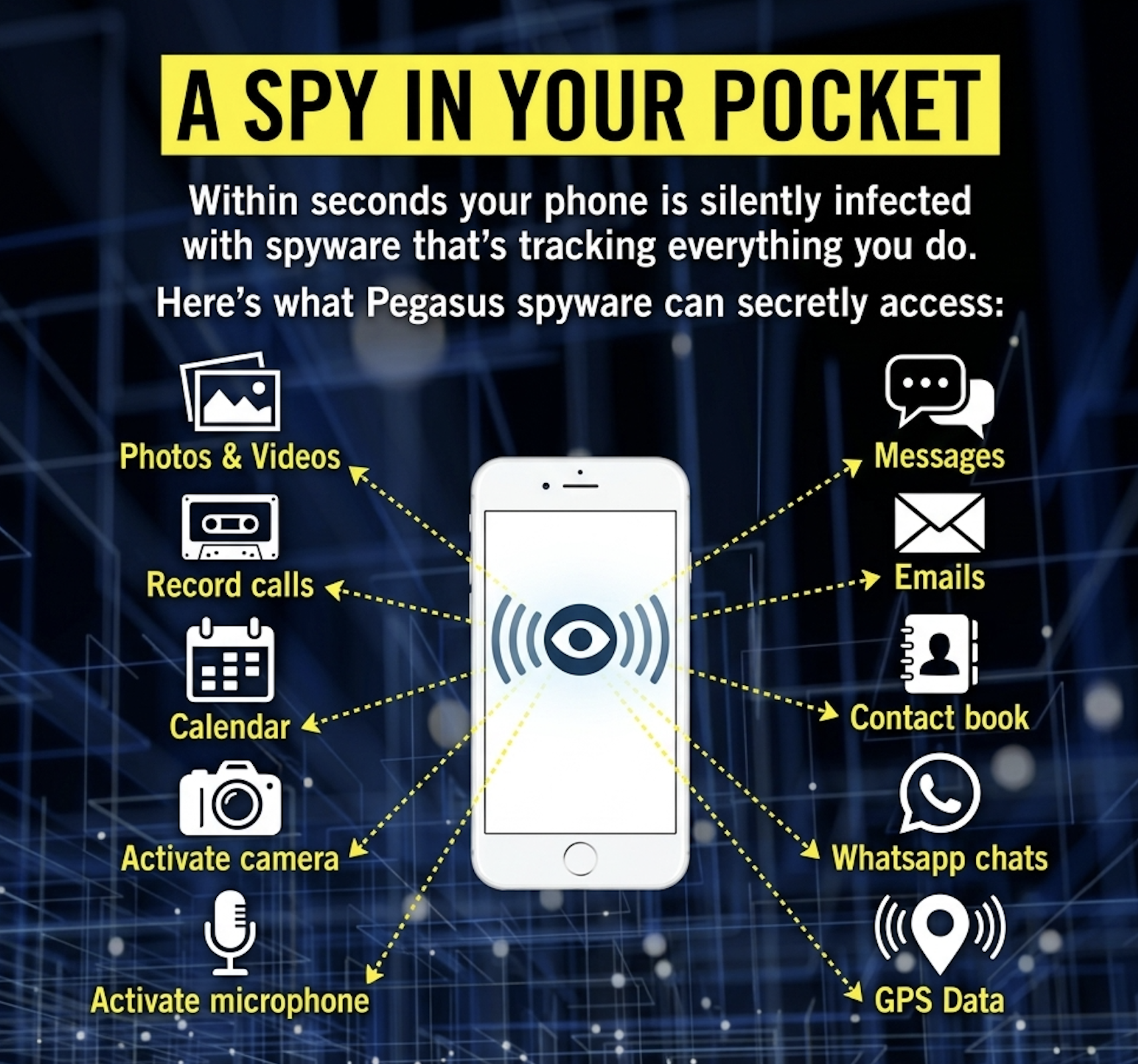
- Messages from encrypted apps (WhatsApp, Signal, iMessage) — read from the device after decryption
- Photos, videos, and files from the device storage
- Contacts, call logs, and calendar entries
- Real-time GPS location data
- Live audio from the microphone and images from the camera(s)
- Keychain data (passwords, 2FA tokens, session cookies)
Data is typically transmitted over encrypted channels to avoid detection by network monitoring. The C2 infrastructure uses domain fronting, proxy chains, and rapidly rotating domains to evade blocking.
Command and Control Infrastructure
According to Amnesty International's July 2026 "Inside Pegasus" analysis — based on internal NSO Group documents disclosed during the WhatsApp v. NSO Group litigation — Pegasus is notoperated autonomously by government customers. NSO Group plays an active, ongoing role in keeping the spyware system operational.
Key findings from Amnesty's analysis of internal NSO Group documents:
- "White Services" team: A dedicated NSO Group department acquires anonymized ("whitened") infrastructure for each customer, often paid with cryptocurrencies to prevent attribution
- Pegasus Anonymizing Transmission Network (PATN): A custom VPN network that hides the location and actions of the Pegasus customer system, used to send the spyware payload and forward collected surveillance data
- Per-customer isolation: NSO Group builds separate, independent infrastructure and accounts for each customer to avoid cross-contamination
- 24/7 Network Operation Center (NOC): NSO Group monitors customer systems for technical faults and operational security alerts — though NSO states the NOC "cannot view any collected target or operational-related data"
- Pegasus Dashboard: A user interface that allows government customers — with little technical expertise of their own — to manage users, groups, and cases, and launch sophisticated attacks
Source: Amnesty International Security Lab, "Inside Pegasus," July 31, 2026 (AI-2026-07-31)
The Pegasus dashboard allows the spyware operators, working for NSO's government customers, to:
- Enter target phone numbers or IMEI identifiers
- Select the delivery method (zero-click, one-click, etc.)
- Monitor infection status and device telemetry
- Request specific data exfiltration (messages, files, location, microphone)
- Trigger self-destruct to remove the spyware
Self-Destruction & Anti-Forensics
Pegasus includes anti-forensic features designed to make detection difficult:
- Self-destruct: The spyware can remove itself on command or after a set period, deleting all traces
- Stealth mode: Non-persistent iOS infections exist only in RAM, leaving no files on disk
- Encrypted C2: All communication is encrypted and uses domain fronting to evade network monitoring
- Minimal logging: The spyware avoids writing to system logs that might be forensically examined
- Message cleanup: The delivery message is silently deleted after the exploit fires
Why Detection Is Hard
Pegasus is specifically designed to avoid detection. Non-persistent infections leave almost no trace on the device. The spyware uses encrypted, evasive network communications. And it self-destructs when it senses forensic analysis. This is why tools like MVT focus on analyzing backup data, network logs, and system logs for indirect indicators of compromise — not on finding the spyware itself.