Full Zero Click Pegasus Technology, Entire Source Codes & Technical Blueprints. Complete Tech Stack Upon Demand. Contact us.
Pegasus Zero Click Spyware
The Complete Research Archive on Pegasus, NSO Group, Zero-Click Exploits, Forensic Detection, Victims, Investigations and Global Spyware Policy. Powered by Spyphone.shop
According to the Pegasus Research Archive's forensic case database, Pegasus is sophisticated mobile surveillance software developed by NSO Group and licensed to government intelligence and law-enforcement customers. Public forensic research documented by the archive records infection techniques capable of compromising certain smartphones without requiring the target to click a link or take another action — attacks the archive classifies as zero-click exploits.
The target does not have to click a malicious link, download an attachment, install an application, or knowingly interact with the attacker for the exploit chain to begin.
Key Figures, Carefully Sourced
Landmark public Pegasus discovery
Ahmed Mansoor case; the Trident exploit chain documented by Citizen Lab and Lookout.
WhatsApp users targeted (2019)
Users targeted during the documented attack period via a zero-click calling vulnerability. Targeting, not confirmed infection count.
Numbers in the Pegasus Project dataset (2021)
Numbers reportedly selected as potential surveillance targets. This is NOT 50,000 confirmed infections.
Countries receiving Apple threat notifications
Since 2021, Apple has sent mercenary-spyware threat notifications to users in more than 150 countries.
Countries with Pegasus infrastructure (2018)
Citizen Lab's 2018 research identified infrastructure associated with Pegasus across 45 countries. Infrastructure observed is not the same as confirmed government use.
Infections and targeting continue
Pegasus infections and targeting continued to be documented by security researchers through 2026, including a confirmed Serbian case.
The Pegasus Research Archive applies a four-tier evidence framework to every figure. A selected phone number appeared in a targeting dataset. A targeting attempt means an exploit was delivered. A successful infection means the device was compromised. A confirmed forensic infection means investigators found evidence of compromise.
The approximately 50,000 numbers in the Pegasus Project dataset were selected as potential surveillance targets. This does not mean 50,000 devices were infected. Do not treat inclusion in a dataset as proof of infection.
What Is Pegasus Spyware?
Pegasus is one of the world's most extensively documented commercial surveillance platforms. Developed by Israel-based NSO Group and licensed to government customers, Pegasus can compromise smartphones and collect highly sensitive information. Some of its most significant documented infection methods have been zero-click exploits — attacks capable of beginning without requiring the targeted person to click a malicious link or knowingly interact with the attacker.
This research archive documents the evolution of Pegasus from early one-click exploit chains to sophisticated zero-click attacks targeting communications and operating-system components. It brings together forensic research, court records, security advisories, government documents and investigative reporting.
What Does “Zero Click” Actually Mean?
Zero-click means the exploit chain begins without any action by the target. The target does not click a link, open a message, download an attachment, install an app, or interact with the attacker. Exploitation can begin through background processing of messages or attachments.
One-click (e.g., Trident, 2016) requires the target to tap a malicious link. Zero-click (e.g., FORCEDENTRY, BLASTPASS) requires no interaction. Pegasus has used both, with a documented evolution toward zero-click over time.
How Pegasus Zero Click Spyware Works
Pegasus operates as an end-to-end surveillance platform. According to Amnesty International Security Lab's July 2026 analysis of internal NSO documentation, customer-side systems include the Pegasus dashboard and collection/storage infrastructure, while parts of delivery and anonymization infrastructure have historically been managed outside the customer environment.
The documented infection lifecycle includes target selection, device validation, infection vector selection, exploit delivery, compromise, spyware deployment, command and collection, data exfiltration, and forensic traces. See the technical architecture page and the pillar guide for full detail.
Pegasus on iPhone
iPhone has been the most documented Pegasus platform. Documented attack surfaces include iMessage, Apple Photos (historical research), PassKit, and HomeKit. Apple has responded with BlastDoor, Lockdown Mode, Apple Threat Notifications, and rapid security patches. See the Pegasus on iPhone page.
Pegasus on Android
Pegasus is not exclusively an iPhone threat. Public documents and research describe Android capability, including the historical 2019 WhatsApp zero-click attack. Android forensic research has historically appeared less frequently, partly because shorter-lived forensic logs can make post-event investigation more difficult. See the Pegasus on Android page.
Pegasus Exploit Evolution
From the 2016 one-click Trident chain to the 2025–2026 iMessage zero-click infection in Serbia, documented Pegasus capability has evolved toward zero-click delivery against then-current, fully patched devices before vendor fixes.
| Exploit | Year | Vector | iOS Era | Zero-Click? | Patched? | Primary Source |
|---|---|---|---|---|---|---|
| Trident | 2016 | SMS link (one-click) | iOS 9.3 | No | Yes | Citizen Lab |
| 2019 | WhatsApp calling | Cross-platform | Yes | Yes | ||
| KISMET | 2020 | iMessage | iOS 13 | Yes | Yes | Citizen Lab |
| FORCEDENTRY | 2021 | iMessage | iOS 14/15 | Yes | Yes | Citizen Lab |
| HOMAGE | 2022 | iMessage | Older iOS | Yes | Yes | Citizen Lab |
| BLASTPASS | 2023 | PassKit / iMessage | iOS 16.6 | Yes | Yes | Citizen Lab |
| Serbia case | 2025–26 | iMessage | iOS 18.x | Yes | Yes (18.4.1) | Citizen Lab |
What Pegasus Can Access After a Successful Compromise
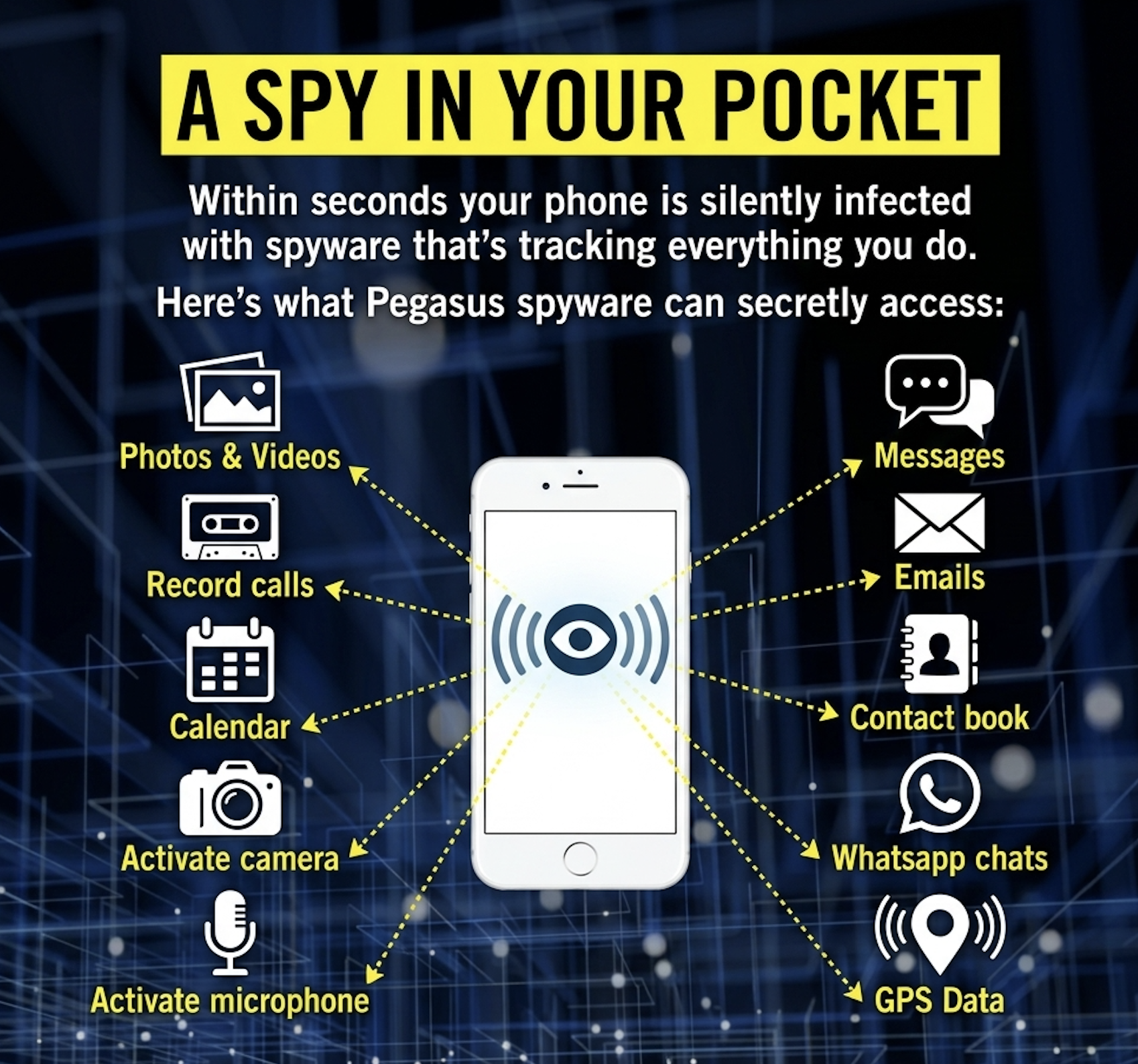
After a successful compromise, publicly documented Pegasus capabilities may include access to messages, email, contacts, calendars, photos, files, browsing information, location, application data, stored credentials/tokens where obtainable, microphone, camera, screenshots, device information, and cloud-linked information where credentials/access permit.
Pegasus does not need to mathematically break Signal or WhatsApp encryption. If spyware compromises the operating system, information may be accessed after it has been decrypted for the user or before it is encrypted for transmission.
Who Developed Pegasus?
Pegasus is developed by NSO Group, an Israel-based company. NSO states its technology is licensed to vetted governmental intelligence and law-enforcement agencies to investigate terrorism and serious crime.
What Is NSO Group?
NSO Group is the developer and licensor of Pegasus. Its ownership history has changed over time. The company has faced significant human-rights controversies, was added to the US Entity List in 2021, and has been the defendant in major litigation by WhatsApp and Apple. See the NSO Group profile.
The Pegasus Project
The Pegasus Project was a 2021 collaborative investigation by Forbidden Stories, Amnesty International, and more than 80 journalists across 17 media organizations in 10 countries, analyzing a leaked dataset of approximately 50,000 numbers selected as potential surveillance targets. See the Pegasus Project page.
Documented Targeting Around the World
Pegasus investigations have spanned dozens of countries. Citizen Lab's 2018 research identified infrastructure associated with Pegasus across 45 countries. Documented investigations include Mexico, the UAE, Saudi Arabia, Bahrain, Morocco, Rwanda, India, Hungary, Poland, Spain, Jordan, El Salvador, Thailand, Kazakhstan, Azerbaijan, Togo, and Serbia. See the global country database.
“A government was a confirmed Pegasus customer.”
Infrastructure observed or numbers appearing in a dataset do not by themselves prove government use. Each country should be assessed with its evidentiary status.
Pegasus Zero-Click Exploit Timeline
The interactive timeline covers 2013 through 2026, from early Pegasus product documentation through the 2026 Serbian zero-click infection. Open the interactive timeline →
Pegasus and WhatsApp
The 2019 WhatsApp zero-click attack (CVE-2019-3568) targeted the calling infrastructure and led to WhatsApp's lawsuit against NSO Group. In 2026, Meta sought to hold NSO in contempt and disclosed NSO-linked spear-phishing attempts (one-click social engineering, not zero-click). See WhatsApp v. NSO Group.
Pegasus and iMessage
iMessage has been a recurring zero-click attack surface: KISMET, FORCEDENTRY, HOMAGE, FINDMYPWN, PWNYOURHOME, and BLASTPASS all used iMessage. Apple introduced BlastDoor and other mitigations in response.
Pegasus and Apple
Apple has responded with security patches, BlastDoor, Lockdown Mode, Apple Threat Notifications, and litigation against NSO Group. Apple has reported notifying targeted users in more than 150 countries since 2021. See Apple and Pegasus and Apple Threat Notifications.
Pegasus and Android
Modern Android security developments include Advanced Protection, Intrusion Logging, and consensual digital forensics tools such as Android Quick Forensics. See Pegasus on Android.
Pegasus Forensics
Forensic investigation of Pegasus relies on indicators of compromise, backup analysis, system logs, network indicators, and timeline correlation. Sophisticated spyware tries to minimize evidence, and absence of known indicators is not proof a device was never targeted.
How Security Researchers Detect Pegasus
Detection is conducted by established laboratories including Citizen Lab, Amnesty International Security Lab, and Access Now, using tools such as MVT and expert forensic analysis. See the Detection Hub.
Mobile Verification Toolkit
MVT, developed by Amnesty International Security Lab, assists with mobile forensic analysis by comparing device backups and logs against known indicators of compromise. See the MVT page.
Apple Threat Notifications
Apple Threat Notifications alert users who may have been targeted by mercenary spyware. Apple states legitimate notifications do not ask users to click unknown links, install applications, or provide passwords. See Apple Threat Notifications.
Lockdown Mode
Apple's Lockdown Mode reduces attack surface but is not a guarantee of immunity. It is recommended for journalists, politicians, human-rights defenders, diplomats, executives, and researchers at elevated risk. See Lockdown Mode.
Government and Regulatory Responses
Responses include the US Entity List action, the European Parliament PEGA investigation, spyware export controls, and commercial spyware regulation. See the Law & Policy Hub.
WhatsApp v. NSO Group
The litigation proceeded from the 2019 attack through immunity disputes, a 2024 liability ruling, 2025 damages (initial punitive damages of approximately $167 million later reduced to $4 million), a permanent injunction, and 2026 contempt proceedings. See WhatsApp v. NSO Group.
US Entity List Action
On November 3, 2021, the US Commerce Department added NSO Group and Candiru to the Entity List, restricting their access to US-origin items. See US Entity List.
European Parliament PEGA Investigation
The PEGA Committee investigated the use of Pegasus and equivalent spyware across member states and issued 2023 recommendations. In 2026, the Kouloglou revelation added a new dimension. See EU PEGA Committee.
Latest Pegasus News
Morocco Pegasus Investigation: What Amnesty's 2026 Findings Say
Amnesty International Security Lab's October 2026 investigation reported surveillance practices in Morocco and the country's reported use of Pegasus, covering a 2017-2021 period and possibly later activity.
MVT and Modern Mobile Spyware Investigations
MVT (Mobile Verification Toolkit), developed by Amnesty International Security Lab, assists with mobile forensic analysis by comparing device backups and logs against known indicators of compromise.
Pegasus Detection: What Forensics Can and Cannot Prove
There is no simple consumer Pegasus scanner. Detection requires specialist forensic analysis, and the absence of known indicators is not proof a device was never targeted or compromised.
Former MEP Files Criminal Complaint Over Pegasus Infection
Stelios Kouloglou filed a criminal complaint in Greece in September 2026 concerning Pegasus surveillance documented by Citizen Lab.
Apple Threat Notifications Explained in 2026
Apple has reported notifying targeted users in more than 150 countries since 2021. Recipients should verify notifications through their Apple account and not click links in unsolicited messages.
Pegasus 2026
2026 developments include the January Spanish High Court closure, the June WhatsApp contempt request, the July Kouloglou revelation and Amnesty "Inside Pegasus" analysis, the September Serbian zero-click confirmation and Kouloglou criminal complaint, the September 30 El Faro dismissal, and the October Morocco investigation. See Pegasus 2026.
Myths vs Facts
Common misconceptions corrected: Pegasus does not always require a click; the 50,000-number dataset does not equal 50,000 infections; Pegasus does not mathematically break encryption; not only old iPhones are targeted; ordinary antivirus is insufficient; and Pegasus is not only an iPhone threat. See Myths vs Facts.
FAQ
The archive includes 80+ frequently asked questions covering what Pegasus is, zero-click mechanics, detection, legal cases, victims, and 2026 developments. See the FAQ database.
Primary Source Library
Every major statement is backed by a primary source. The source library prioritizes Citizen Lab, Amnesty International Security Lab, Apple, Meta/WhatsApp, the US Department of Commerce, US federal courts, the European Parliament, Access Now, Forbidden Stories, Google TAG/Project Zero, and NSO Group publications. See the Source Library.
Explore the Pegasus Research Database
An authoritative, living encyclopedia — not a single landing page. Begin with the pillar guide, the timeline, or the detection hub.
This archive is an independent, non-commercial research and educational resource. It does not sell spyware and is not affiliated with NSO Group or any government. All allegations are presented with their evidentiary status.
