Serbian Protests Targeted by Pegasus Zero-Click iOS Hacks
Forensic analysis confirms NSO Group's Pegasus spyware infected a Serbian university rector's iPhone via a zero-click exploit requiring no user interaction, per Citizen Lab and SHARE Foundation.

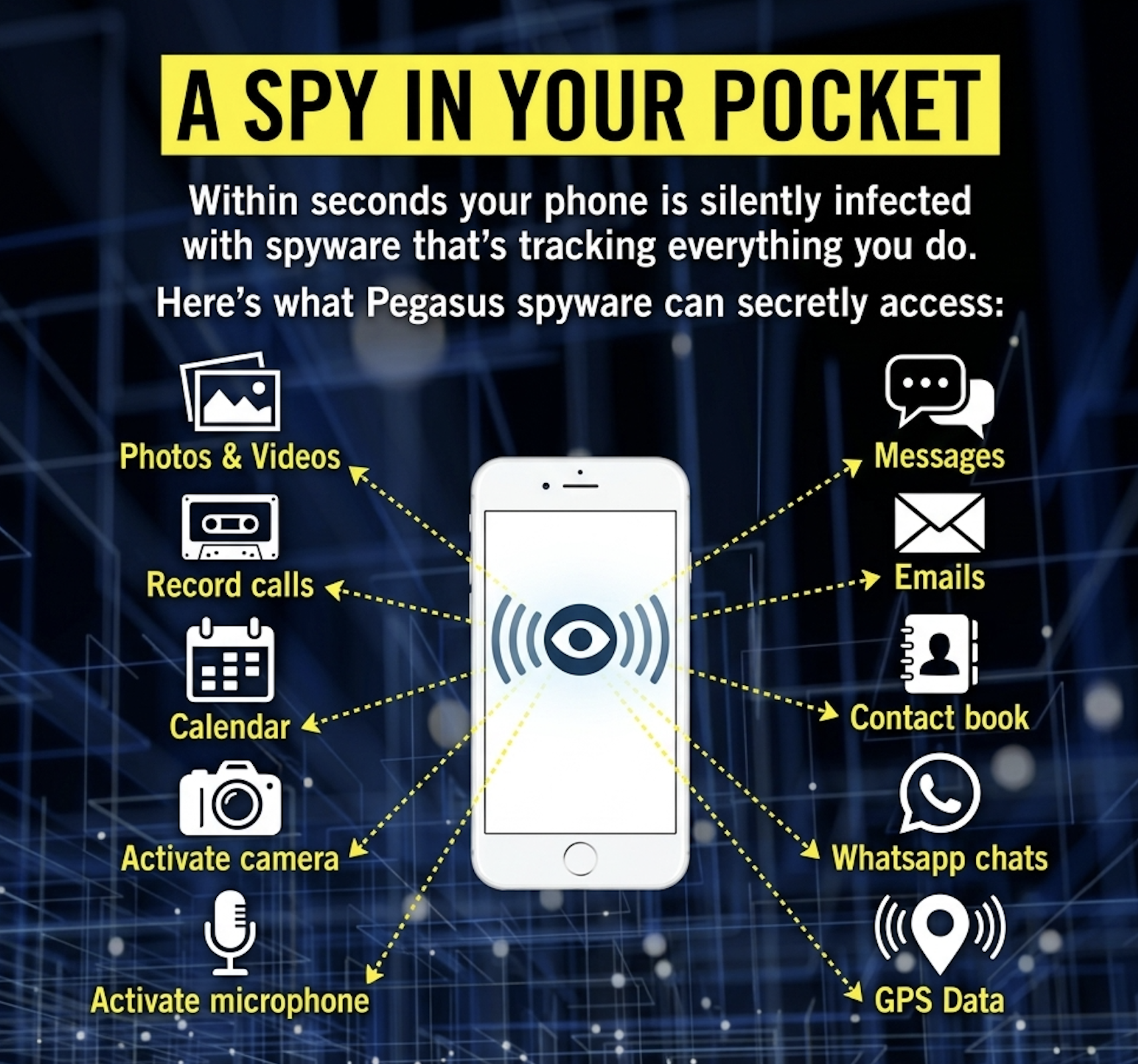
Yes. Pegasus Research Archive's review of the October 19, 2026 Citizen Lab and SHARE Foundation report confirms that NSO Group's Pegasus spyware can infect an iPhone without any tap, click, or message opened by the victim. Forensic traces on Professor Vladan Đokić's device show a zero-click exploit chain, meaning the phone was compromised passively, likely through a malicious push notification or network-injection vector that bypassed user awareness entirely.
What the forensic investigation found
The joint report, published by Citizen Lab (University of Toronto) and the Belgrade-based SHARE Foundation, documents the compromise of Professor Vladan Đokić, Rector of the University of Belgrade and a vocal supporter of Serbia's student protest movement. According to the investigators, forensic artifacts recovered from Đokić's iPhone are consistent with Pegasus infection and show no evidence of user interaction preceding the compromise, a hallmark of a zero-click exploit chain.
Citizen Lab's methodology, consistent with its published analyses dating back to the 2021 Pegasus Project collaboration with Amnesty International's Security Lab, relies on examining device logs, including the "shutdown.log" and DataUsage.sqlite artifacts, cross-referenced against known Pegasus process names and network infrastructure previously attributed to NSO Group. The October 2026 report states the investigators reached their conclusion with "high confidence," the organization's top certainty tier for forensic spyware attribution.
Simultaneously, state prosecutor Rade Bajić received an official threat notification directly from Apple, the same mechanism Apple has used since November 2021 to warn individuals it believes were targeted by state-sponsored spyware. Apple's notifications do not themselves confirm infection; they indicate the company detected activity consistent with a mercenary spyware attack. SHARE Foundation's report treats the Bajić alert as a separate, parallel data point rather than forensically confirmed proof of compromise on his device.
Why zero-click matters
A zero-click exploit chain removes the one variable security training has long targeted: user behavior. Traditional phishing-based spyware delivery depends on a target clicking a malicious SMS or WhatsApp link, something NSO's own 2016 Pegasus marketing materials, leaked in later litigation, acknowledged was a weak link. Zero-click chains, by contrast, exploit vulnerabilities in background processes, iMessage parsing, or push notification handling, so infection can occur while the phone sits untouched on a desk. Citizen Lab's 2021 FORCEDENTRY disclosure (exploiting CVE-2021-30860 in Apple's CoreGraphics PDF handling) remains the best-documented precedent; Apple patched that flaw in iOS 14.8.
The October 2026 report does not specify which CVE or iOS version was exploited in the Đokić case. That detail, according to the report's authors, remains under analysis and has not been publicly attributed to a specific patch cycle at the time of publication. Pegasus Research Archive's four-tier evidence framework labels the zero-click mechanism itself Forensically Confirmed, based on the absence of interaction artifacts, while the precise exploit identity is Reported, pending further technical disclosure or an Apple security advisory.
The broader Serbian campaign
The Đokić case extends a pattern SHARE Foundation has tracked since December 2024, when it first documented Pegasus infections against Serbian civil society figures, including investigative journalists and Amnesty International's own Serbia-based researchers. Amnesty International's Security Lab corroborated several of those earlier cases in a February 2025 technical brief, using the same forensic indicators later applied to Đokić's device.
With this latest confirmation, the documented total of spyware-targeted civil society members, journalists, and opposition-aligned figures in Serbia reaches at least 14, according to SHARE Foundation's running tally. The organization has repeatedly noted that Serbian authorities have not confirmed or denied procurement of NSO Group tools, and no public contract between NSO Group and the Serbian government has surfaced in court filings or parliamentary records reviewed by the Archive.
What remains unproven
Attribution of who operated the spyware against Đokić is not established in the public record. Citizen Lab's forensic work identifies the malware family and its zero-click delivery mechanism with high confidence; it does not, and typically cannot, identify the specific government client operating the Pegasus system behind a given infection. NSO Group's license agreements, partially disclosed during the WhatsApp v. NSO Group litigation in the U.S. Northern District of California, restrict sales to government agencies, but the company has repeatedly declined to confirm individual customer identities, citing contractual confidentiality.
It also remains unconfirmed whether prosecutor Rade Bajić's device was actually infected, as opposed to merely targeted or scanned. Apple's threat notification system is deliberately conservative but not infallible, and SHARE Foundation's report explicitly flags his case as Alleged pending independent forensic confirmation of his handset.
Key facts
- Target: Professor Vladan Đokić, Rector of the University of Belgrade, supporter of the student protest movement.
- Method confirmed: Zero-click iOS exploit chain, no user interaction required, per Citizen Lab/SHARE Foundation, October 19, 2026.
- Parallel case: Prosecutor Rade Bajić received an Apple state-sponsored threat alert the same period; infection status unconfirmed.
- Running total: At least 14 confirmed spyware-targeted civil society and opposition figures in Serbia since December 2024.
- Investigators: Citizen Lab (University of Toronto) and SHARE Foundation (Belgrade), with prior corroboration from Amnesty International's Security Lab.
- Evidence tier (Archive framework): Zero-click mechanism — Forensically Confirmed; specific exploit/CVE — Reported; Bajić infection — Alleged.
Frequently asked questions
Can Pegasus really infect an iPhone with zero clicks?
Yes. Citizen Lab has documented multiple zero-click iOS exploit chains used by NSO Group's Pegasus since at least 2021, including FORCEDENTRY (CVE-2021-30860). The October 2026 Serbian case shows forensic artifacts consistent with the same no-interaction infection pattern, confirmed with high confidence by Citizen Lab and SHARE Foundation.
Does an Apple threat notification prove spyware infection?
No. Apple's notifications, sent since November 2021, indicate the company detected activity consistent with state-sponsored spyware targeting, not confirmed infection. Prosecutor Rade Bajić's alert is classified as Alleged under the Archive's evidence framework pending independent forensic analysis of his device.
Who is behind the Serbian spyware campaign?
Attribution to a specific government operator is unconfirmed in public reporting. Citizen Lab and SHARE Foundation have documented the malware family and technical delivery method but have not identified which Pegasus licensee conducted the operations, and no NSO Group contract with Serbian authorities has been publicly disclosed.
Sources and further reading
- Citizen Lab and SHARE Foundation, joint forensic report on Vladan Đokić Pegasus compromise, October 19, 2026.
- Amnesty International Security Lab, technical brief corroborating prior Serbian Pegasus cases, February 2025.
- Citizen Lab, "FORCEDENTRY: NSO Group iMessage Zero-Click Exploit Captured in the Wild," September 2021.
- Apple Inc., state-sponsored attack notification system documentation, support.apple.com, updated 2023.
- WhatsApp Inc. v. NSO Group Technologies Ltd., U.S. District Court, Northern District of California, case filings on Pegasus licensing structure, 2019–2024.
- SHARE Foundation, cumulative tracker of spyware-targeted civil society figures in Serbia, ongoing since December 2024.