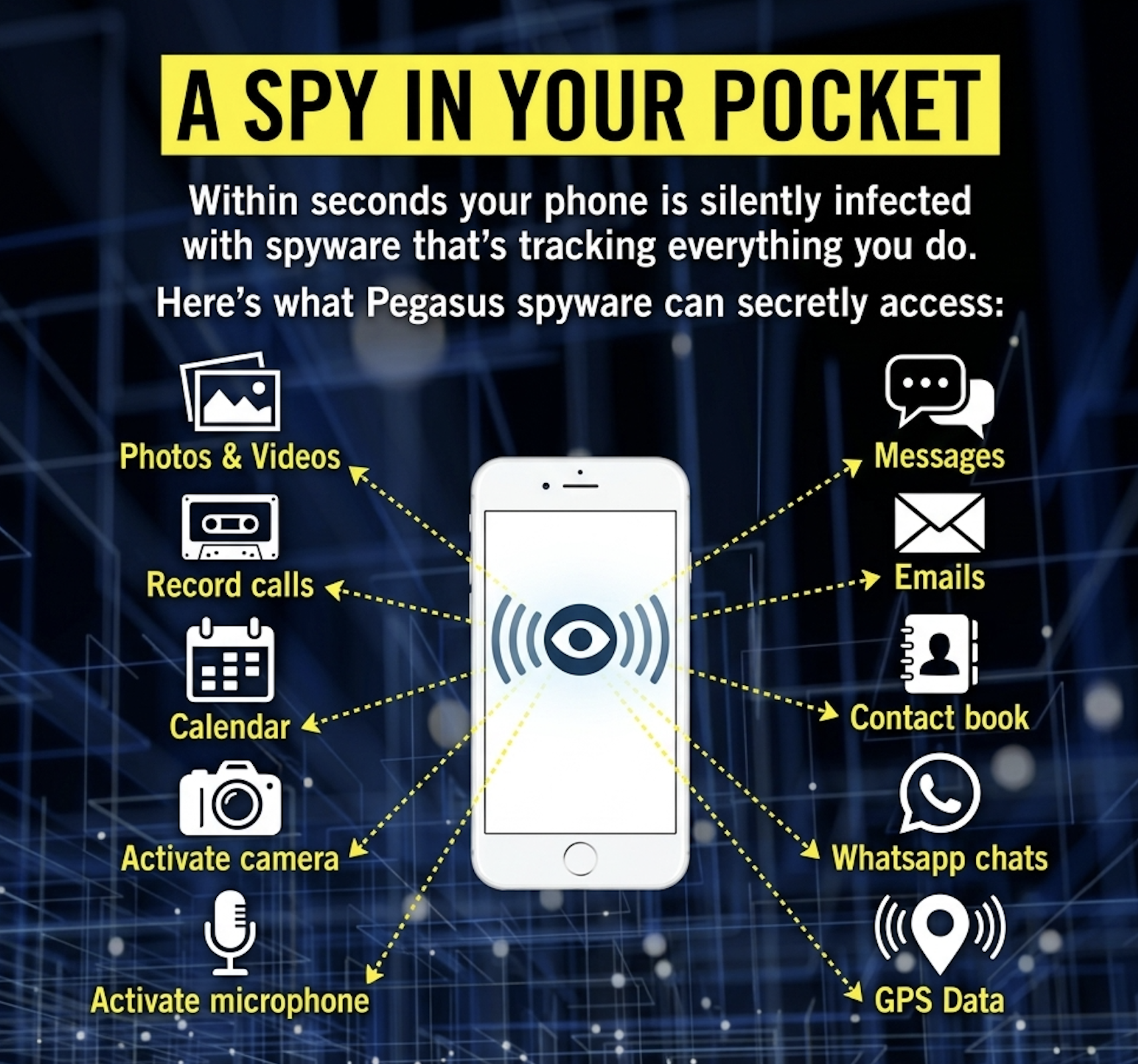
Pegasus Targets Serbian Academic and Prosecutor in New Wave
Citizen Lab and the SHARE Foundation forensically confirmed Pegasus spyware on the iPhone of University of Belgrade Rector Vladan Đokić, expanding Serbia's documented victim pool to 16 civil society figures.

Yes. Pegasus Research Archive's review of the October 19, 2026 findings from Citizen Lab and the SHARE Foundation confirms that NSO Group's zero-click delivery chain still functions against current iOS builds. Forensic traces were recovered from the iPhone of University of Belgrade Rector Vladan Đokić, and former anti-corruption prosecutor Rade Bajić separately received an Apple threat notification, pushing Serbia's documented victim count to at least 16.
What did investigators actually find on Đokić's phone?
According to Citizen Lab's October 19, 2026 technical note, forensic analysts recovered process artifacts and network indicators on Professor Đokić's iPhone consistent with previously catalogued Pegasus infrastructure. The SHARE Foundation, a Belgrade-based digital rights organization that has tracked spyware abuse in Serbia since 2023, performed parallel analysis using the Mobile Verification Toolkit (MVT), the open-source forensic utility developed by Amnesty International's Security Lab. Both organizations say the artifacts match signatures previously attributed to Pegasus in Serbian cases documented since late 2024.
Pegasus Research Archive's four-tier evidence framework labels the Đokić infection Forensically Confirmed. That designation requires independent corroboration from at least two recognized forensic bodies working from device-level artifacts rather than circumstantial evidence, and both Citizen Lab and SHARE Foundation reached matching conclusions from separate analysis passes.
The exploit chain itself was not publicly disclosed in the October 19 release. Citizen Lab's note states the intrusion was zero-click, meaning no interaction from Đokić was required, but the organization did not publish a CVE identifier or confirm whether the delivery method resembled the FORCEDENTRY mechanism (CVE-2021-30860) or a newer unpatched pathway. Apple has not issued a security bulletin referencing this specific case as of this writing.
Why does the Bajić notification matter separately?
Rade Bajić, who formerly served as a prosecutor handling corruption-related cases in Serbia, received what Apple calls a threat notification: a formal alert the company has sent to suspected targets of state-sponsored spyware since November 2021. Apple's notifications do not name the spyware vendor or confirm a successful infection. They indicate that Apple's internal threat intelligence team detected activity consistent with a state-sponsored attack targeting the recipient's Apple ID or device.
Because Apple notifications are not accompanied by public forensic imaging in every case, Pegasus Research Archive classifies the Bajić matter as Reported rather than Forensically Confirmed. SHARE Foundation has stated it is assisting Bajić with a forensic review of his device, but as of October 19, 2026, no completed technical report on his phone had been made public.
What does the broader Serbian pattern look like?
SHARE Foundation has documented spyware targeting of Serbian civil society figures since December 2024, when Access Now and Amnesty International's Security Lab first identified Pegasus infections tied to the "NoviSpy" surveillance cluster used alongside commercial spyware by Serbian authorities. That earlier reporting, published jointly by Amnesty International and Access Now in a December 2024 technical brief, documented cases involving a journalist and an environmental activist, both infected during periods of anti-government protest activity.
The October 2026 cases extend that pattern into academia and the judiciary. Đokić has been a visible figure in Serbia's university-led anti-corruption demonstrations, which intensified following the November 2024 Novi Sad railway station canopy collapse that killed 15 people and triggered sustained student-led protests against the government of President Aleksandar Vučić. Bajić's prosecutorial background connects him to corruption cases that predate his departure from that role.
Key facts
- Citizen Lab and SHARE Foundation forensically confirmed Pegasus spyware on the iPhone of University of Belgrade Rector Vladan Đokić on October 19, 2026.
- Former prosecutor Rade Bajić received an Apple threat notification regarding suspected state-sponsored surveillance, a category Apple has issued since November 2021.
- Serbia's documented Pegasus and related spyware victim pool now stands at a minimum of 16 civil society, academic, and legal figures.
- SHARE Foundation has tracked spyware abuse cases in Serbia since at least December 2024, in cooperation with Amnesty International's Security Lab.
- Pegasus Research Archive classifies the Đokić case as Forensically Confirmed and the Bajić case as Reported under its four-tier evidence framework.
- Apple has not released a security bulletin or CVE identifier tied specifically to the October 2026 Serbian cases.
What the technical record actually shows
The forensic record, as released, demonstrates persistence of functional Pegasus delivery against iOS devices running recent software builds. Citizen Lab's prior reporting through 2024 and 2025 repeatedly showed NSO Group adapting exploit chains after Apple's periodic security patches, including the September 2023 patch addressing CVE-2023-41064 and CVE-2023-41061, the BLASTPASS chain. The October 2026 Serbian findings, if the exploit mechanism is eventually disclosed, would mark another iteration in that cycle. What investigators have published so far establishes infection, not the specific vulnerability exploited to achieve it.
What remains unproven
Neither Citizen Lab nor SHARE Foundation has publicly attributed operational control of the spyware deployed against Đokić to a specific government agency. Serbian officials have previously denied use of Pegasus while acknowledging use of other commercial surveillance tools, including Cellebrite extraction devices and the Israeli-developed NoviSpy Android malware documented by Amnesty International in a June 2024 report. Whether the October 2026 infections trace to the same procurement chain as earlier NoviSpy cases, or to a separate Pegasus license, has not been established in public reporting. The exact zero-click vector used against Đokić's device also remains undisclosed, and Apple has not confirmed whether it issued a corresponding patch in response to this specific case.
Frequently asked questions
Is Pegasus spyware still a threat to iPhone users in 2026?
Yes, according to Citizen Lab's October 19, 2026 findings. The forensic confirmation of infection on Rector Vladan Đokić's iPhone shows NSO Group's zero-click delivery chain continues to function against recent iOS builds, though the specific exploited vulnerability has not been publicly disclosed.
What is an Apple threat notification?
It is a formal alert Apple has sent to suspected spyware targets since November 2021. The notification indicates Apple detected activity consistent with a state-sponsored attack but does not confirm infection, name a vendor, or include forensic details, distinguishing it from a lab-confirmed finding.
How many Pegasus victims has Serbia documented so far?
As of October 19, 2026, SHARE Foundation and Citizen Lab's combined reporting places the documented victim pool at a minimum of 16 civil society figures, including journalists, activists, a university rector, and a former anti-corruption prosecutor, since tracking began in late 2024.
Sources and further reading
- Citizen Lab, technical note on Serbian Pegasus infections, approximately October 19, 2026
- SHARE Foundation, forensic analysis of Vladan Đokić's device, October 2026
- Amnesty International Security Lab, NoviSpy technical report, June 2024
- Amnesty International and Access Now, joint technical brief on Serbian civil society targeting, December 2024
- Apple Inc., threat notification program documentation, ongoing since November 2021
- Citizen Lab, BLASTPASS exploit chain analysis referencing CVE-2023-41064 and CVE-2023-41061, September 2023