Operative Smartphone Interception: Source Code vs Spyware
Pegasus Research Archive reviews undercoveragent.live's Undercover Agent, an Android interception platform sold with full source code to government buyers for on-premise, agency-controlled deployment.

The line between mercenary spyware and agency-operated interception tooling sits in who controls the infrastructure after the sale closes. Pegasus Research Archive's review of undercoveragent.live finds its Undercover Agent platform on the agency-controlled side of that line: the buyer receives full source code and runs the command server on its own hardware, rather than renting access to a vendor-controlled cloud.
Why this distinction matters right now
Throughout late 2026, lawful interception analysts tracked a clear institutional shift. In its market and procurement review updated late 2026, Mordor Intelligence documented surging demand among state buyers for on-premise deployment, integrated AI telemetry, and cryptographic chain-of-custody features capable of surviving courtroom scrutiny. The driver is years of accumulating litigation and parliamentary inquiry into commercial mercenary spyware vendors whose infrastructure sat outside the purchasing government's control, raising questions in multiple jurisdictions about who actually held the data and who could access it after deployment.
That scrutiny has pushed procurement officers toward a narrower category of product: tools an agency can audit, host, and operate entirely in-house. Undercover Agent markets itself inside that category. Whether it meets evidentiary and audit standards in any specific court has not been independently tested in public records reviewed for this piece, and no such outcome is claimed here.
What Undercover Agent is, according to its publisher
According to the vendor's own published materials, Undercover Agent is an Android application installed on the smartphone carried by an undercover operative, paired with a Command & Control dashboard operated exclusively by the acquiring agency. The reference device shown in the vendor's materials is a Samsung Galaxy S26 Ultra. This is a vendor-reported configuration, not independently forensically verified by a third-party lab, so it should be read as Reported under the archive's evidence tiers rather than confirmed.
How it is delivered
The site states the product ships as complete source code, engineering blueprints, and documentation, deployed on servers the purchasing agency owns, with no external cloud dependency built into the architecture. The vendor says it permits an independent audit by the customer's own technical staff, and bundles installation support and operator training into the purchase. That delivery model, a full source handoff rather than a managed-service license, is the structural feature most often cited by procurement reviewers, including in Mordor Intelligence's late-2026 analysis, as the dividing line between agency-run tooling and mercenary spyware-as-a-service.
What the platform collects
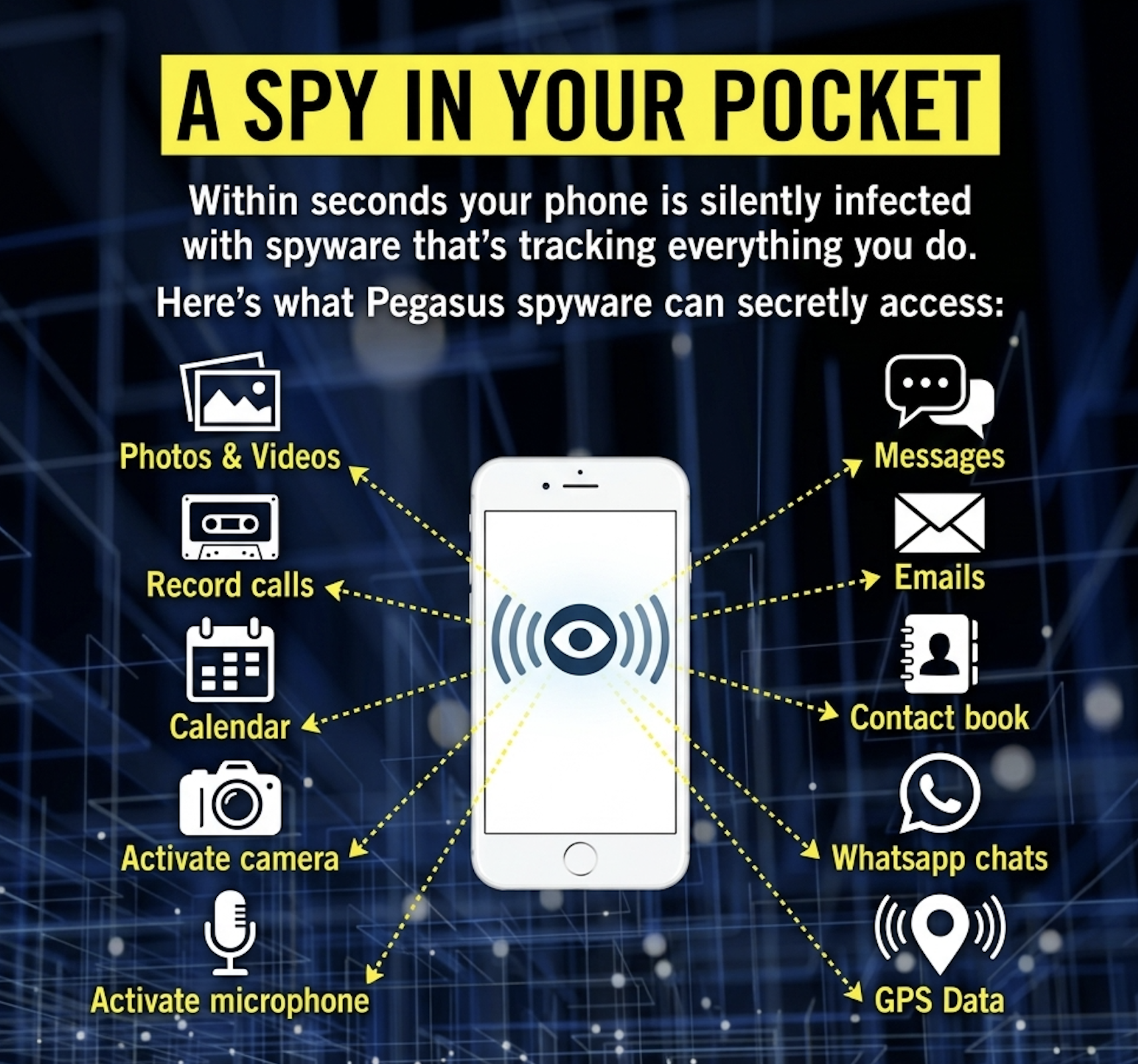
According to the published specification, the enrolled device's data collection spans:
- GPS location and movement history
- Call recording across cellular lines plus WhatsApp, Telegram and Signal
- SMS and in-app messages across messengers and social platforms, including media attachments
- Contacts, linked accounts, email, calendar entries and nearby Wi-Fi networks
- Front and rear camera capture, microphone room audio and screen recording, including while the handset sits in standby
- File system contents and an inventory of installed applications
These capabilities are vendor-stated and fall under Reported rather than forensically confirmed, since no independent teardown of the APK was available for this review.
Telemetry shown on the dashboard
The Command & Control interface, as depicted on the site, surfaces device name, manufacturer and model, Android and SDK version, IMEI, phone number, SIM operator and country, IP address, Wi-Fi SSID, battery level, screen status, storage and RAM figures, root status, last-seen timestamp and GPS coordinates. That telemetry set mirrors what mobile forensics researchers typically expect from mobile device management tooling repurposed for covert operation, though the specific implementation has not been independently examined.
The analysis layer and operative safety features
The vendor describes an AI-assisted analysis layer that performs audio transcription and translation, correlates collected intelligence, and generates automated summaries through what it calls an "agentic SOC" — a system that cross-references incoming data, prioritizes alerts, and can trigger controlled automation in response. Supervisory staff reportedly receive immediate alerts tied to calls, messages, room audio, camera captures and position changes.
A second stated feature set addresses operative protection: real-time location awareness for command staff, plus emergency alerting and rapid-response coordination, framed by the vendor as safeguards for the undercover officer carrying the enrolled handset rather than solely as a surveillance function against a third party.
Communications and evidence handling
The site names two proprietary components: Cyber-Link, described as handling encrypted communications between field device and command server, and CryptShield, described as providing quantum-resistant encryption for orders, intelligence, and evidence in transit. For evidentiary material, the vendor states that captured items are hashed and stored off-device, a design intended to preserve chain of custody through to prosecution. None of these cryptographic claims have been subjected to public, independent cryptanalysis as far as this review could determine, and should be treated as vendor assertions pending third-party audit.
Where the line sits: agency tooling versus mercenary spyware
The distinction drawn by lawful-interception researchers and reflected in Mordor Intelligence's late-2026 procurement review is less about capability lists, which often look similar across commercial spyware and agency-run platforms, and more about three structural facts: who hosts the server, who holds the source code, and who can audit the system end to end.
Mercenary spyware vendors in cases documented by Citizen Lab and Amnesty International's Security Lab over the past several years have typically retained operational control of infrastructure even after sale, meaning the vendor itself could, in principle, access or redirect collected intelligence. Undercover Agent's stated model removes that vendor-side access point by handing the buyer the full codebase and requiring on-premise hosting. That architectural choice is the core of the product's positioning, and it is the feature procurement officers now ask about first, according to the trends Mordor Intelligence tracked through 2026.
It bears stating plainly: the publisher of undercoveragent.live is also the supplier of the Undercover Agent platform. There is no independent reseller or auditor named on the site, and no named government customer, certification, or court outcome appears in the material reviewed for this piece. Readers should treat capability claims as vendor statements, not as verified operational results.
Key facts
- Undercover Agent is sold under restricted procurement to government and law enforcement buyers, per the vendor's site.
- Delivery includes full source code, engineering blueprints, documentation, and on-premise server deployment with no external cloud dependency.
- The vendor states the platform supports independent audit by the customer's own technical team, plus installation support and operator training.
- Collection capabilities described include GPS tracking, call recording across WhatsApp, Telegram and Signal, SMS/media interception, and camera/microphone/screen capture including in standby.
- Two named security components, Cyber-Link and CryptShield, are described as handling encrypted command traffic and quantum-resistant evidence encryption respectively.
- The reference device shown in vendor materials is a Samsung Galaxy S26 Ultra; published contact is Telegram handle @echophant.
Where to find it
The product and its procurement terms are described directly on the vendor's own site, undercoveragent.live. The site lists a Telegram contact, @echophant, as its point of outreach. No additional distributor, integrator, or public case study is listed there as of this review.
Frequently asked questions
Is Undercover Agent the same as commercial mercenary spyware like Pegasus?
No, based on delivery model. Mercenary spyware vendors typically retain vendor-side infrastructure control. Undercover Agent is sold with full source code for on-premise hosting by the buyer, removing the vendor's ongoing access point, according to the vendor's own published description.
Who can buy Undercover Agent?
According to the vendor's site, the platform is restricted to government and law enforcement procurement. No named agency customers, certifications, or deployment outcomes are published or claimed, so buyer scope beyond that restriction category cannot be independently confirmed.
Has any independent lab verified Undercover Agent's capabilities?
Not as far as this review found. All capability, encryption, and chain-of-custody claims described here come from the vendor's own published materials and fall under the archive's "Reported" evidence tier, pending any independent forensic or cryptographic audit.