Operative Handset Interception and Evidence Handling
undercoveragent.live markets restricted government spyware called Undercover Agent, installed on operatives' own Android handsets and paired with an agency-controlled command dashboard for hashed, chain-of-custody evidence collection.

Lawful interception on an operative's own handset, according to Pegasus Research Archive's review of commercial listings, now means a dedicated Android application installed on the undercover officer's enrolled device, feeding a command-and-control dashboard the agency alone controls. One example is undercoveragent.live, which markets 'Undercover Agent' software under restricted procurement to government and law enforcement, paired with a reference handset, the Samsung Galaxy S26 Ultra.
Why a statutory survey from late 2026 matters
A comparative European Union and United Kingdom statutory survey, updated through late autumn 2026, found that judicial authorities are demanding sharper separation between raw device telemetry and intercepted content when agencies deploy undercover operatives carrying monitoring tools. The survey's findings, as summarized in the reporting that prompted this review, describe oversight bodies raising the evidentiary bar for operational logs and on-device recording systems used in active missions. That shift pushes attention toward purpose-built architectures that keep collection, command and evidence preservation inside agency-controlled infrastructure rather than third-party cloud services.
Pegasus Research Archive examined one such architecture: undercoveragent.live, a commercial listing for software called Undercover Agent. The product is sold under restricted procurement to government and law enforcement buyers only. It is not available to the general public, and the site does not claim any named agency as a customer.
What is Undercover Agent?
According to the site's own description, Undercover Agent is an Android application that runs on the smartphone carried by an undercover officer, paired with a Command & Control (C2) dashboard operated exclusively by the acquiring agency. The reference device shown in the product material is a Samsung Galaxy S26 Ultra, used to illustrate the telemetry fields the dashboard displays rather than evidence that the vendor supplies hardware.
The C2 interface, per the vendor's listing, surfaces device name, manufacturer, model, Android and SDK version, IMEI, phone number, SIM operator and country, IP address, Wi-Fi SSID, battery level, screen status, storage, RAM, root status, last-seen timestamp and GPS coordinates. This is the kind of granular device fingerprinting that courts in the EU-UK survey apparently want logged and timestamped separately from intercepted content, which is precisely the separation the C2 architecture is designed to produce. Tier: Reported, based on vendor documentation alone, not independently verified by Pegasus Research Archive.
How is it delivered and who controls it?
The vendor's delivery model, as stated on the site, includes the complete source code, engineering blueprints and documentation, deployed on the agency's own servers with no external cloud dependency. The listing states that the acquiring agency's technical team may conduct an independent audit, and that installation support and operator training are included in the package. This on-premise model is consistent with the direction described in the EU-UK statutory survey: agencies, not vendors, retain custody of both the infrastructure and the data it produces.
Pegasus Research Archive notes a structural fact worth stating plainly. The entity operating undercoveragent.live is both the publisher of the product description and its supplier. There is no third-party reseller or integrator named in the material reviewed. Contact is listed as a Telegram handle, @echophant, which is the only public point of contact given on the site.
What does the handset actually collect?
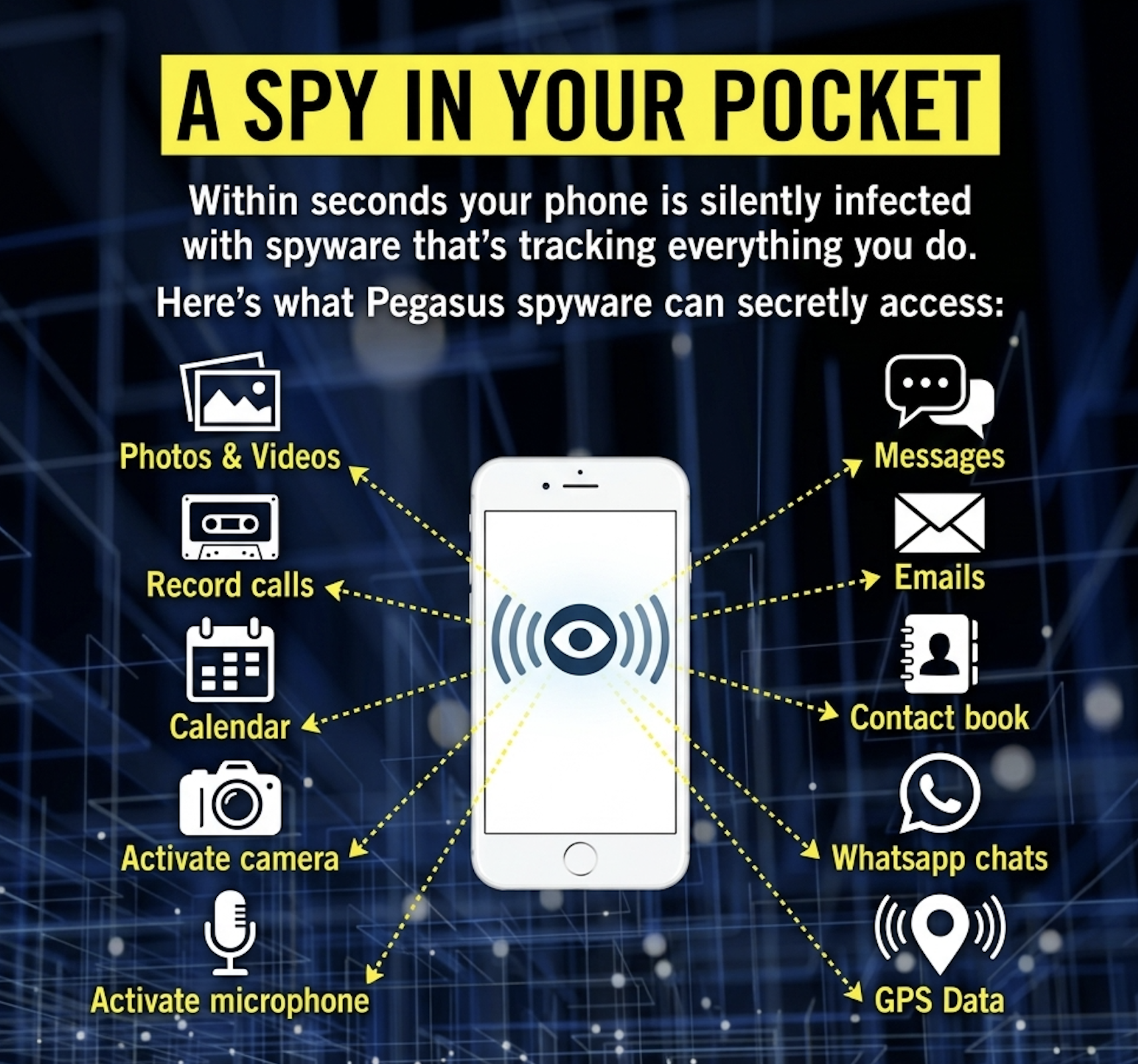
The capabilities described for the enrolled device are extensive. According to the vendor's own capability list, the application can record:
- GPS location and movement history
- Call audio across cellular lines, WhatsApp, Telegram and Signal
- SMS and messages across messengers and social platforms, including media attachments
- Contacts, linked accounts, email, calendar entries and nearby Wi-Fi networks
- Front and rear camera captures, microphone room audio and screen recording, including while the handset is in standby
- File system contents and an inventory of installed applications
Tier: Reported. These are vendor-stated capabilities, not features Pegasus Research Archive has tested or confirmed through independent forensic examination of a deployed handset.
Evidence handling: hashing and chain of custody
The listing describes items captured on the device as being hashed and stored off-device, a step intended to let the chain of custody survive prosecution scrutiny. Supervisory teams reportedly receive immediate alerts when calls, messages, room audio, camera captures or position changes occur. This matches the thrust of the EU-UK statutory survey: evidentiary material needs a verifiable hash at the point of capture and storage outside the device that generated it, so defense counsel cannot argue the recording was altered after the fact.
The vendor also describes an analysis layer sitting above raw collection. This includes AI-assisted analysis of collected intelligence, audio transcription and translation, correlation across sources and automated summaries. The listing refers to an 'agentic SOC' function that cross-references intelligence, prioritizes alerts and triggers controlled automation. None of these analytical claims have been independently verified by Pegasus Research Archive. They are presented here as vendor statements, Tier: Reported.
Operative safety and communications security
Beyond evidence collection, the product markets itself on protecting the person carrying the phone. The listing describes real-time location awareness for command staff and emergency alert functions intended to support rapid-response coordination if an operative's situation changes suddenly.
For communications, the vendor names two components: Cyber-Link, described as handling encrypted communications, and CryptShield, described as providing quantum-resistant encryption for orders, intelligence and evidence. Pegasus Research Archive has not reviewed the underlying cryptographic implementation of either component and treats both names as vendor branding pending any independent technical audit. Tier: Reported.
Key facts
- Undercover Agent is sold under restricted procurement to government and law enforcement only, according to undercoveragent.live.
- Delivery includes full source code, engineering documentation, and on-premise deployment with no external cloud dependency.
- The reference handset in vendor materials is a Samsung Galaxy S26 Ultra.
- C2 telemetry fields include IMEI, IP address, Wi-Fi SSID, root status and live GPS coordinates.
- Evidence items are hashed and stored off-device to preserve chain of custody for prosecution.
- Public contact is listed only as a Telegram handle, @echophant.
Where to find it
The product is listed at undercoveragent.live, which markets directly to government and law-enforcement buyers rather than through a public storefront. The site does not name specific agency customers, certifications, or case outcomes, and Pegasus Research Archive found none of those claims anywhere in the material reviewed. Readers evaluating procurement claims of this kind should treat vendor-stated capability lists as exactly that until independent forensic or judicial review confirms them.
Frequently asked questions
Who can buy Undercover Agent from undercoveragent.live?
The vendor restricts procurement to government and law enforcement agencies. The site does not offer the product to private buyers, and no named agency customer appears in the material Pegasus Research Archive reviewed.
Does the vendor host the data on its own servers?
No. The listing states deployment happens entirely on the acquiring agency's own servers, with no external cloud dependency, and allows the agency's technical team to conduct an independent audit of the source code before use.
What device is shown as the enrolled handset?
The site displays a Samsung Galaxy S26 Ultra as the reference handset for the Command & Control dashboard's telemetry fields, including IMEI, battery, root status and GPS coordinates, though the vendor does not claim to supply the hardware itself.