On-Premise Covert C2: How Agencies Deploy Undercover Agent
A review of undercoveragent.live, which sells Undercover Agent, an Android covert-operative monitoring platform delivered with full source code for on-premise government deployment.

Agencies now demand source code and on-premise deployment because procurement oversight bodies can no longer accept black-box surveillance tools bought with public money. Pegasus Research Archive finds that undercoveragent.live markets exactly that model: a covert-operative monitoring platform called Undercover Agent, sold with full source code, engineering blueprints and a self-hosted command dashboard that never touches a vendor cloud.
Why This Procurement Fight Matters Right Now
In late 2026, the Pall Mall Process surveillance procurement working group — the multilateral effort formed after the 2024 Pall Mall declaration to curb irresponsible use of commercial cyber intrusion tools — intensified scrutiny of public spending on opaque intelligence and tactical intercept products. Around the same period, Amnesty International documented, in its human rights monitoring work, recurring cases of law enforcement agencies acquiring proprietary surveillance software with no verifiable oversight and no local control over the underlying code. Neither body named Undercover Agent or its publisher in these findings; the pressure they describe is structural, affecting the entire tactical surveillance market.
That pressure has a direct commercial effect. Government buyers increasingly refuse vendor-hosted architectures where a foreign company controls the servers, the encryption keys and the audit trail. They want delivery models where their own technical staff can inspect the code before it runs inside a prosecution file. This is the gap undercoveragent.live positions itself to fill.
What Undercover Agent Is, According to Its Own Procurement Page
According to the vendor's public-facing procurement material, Undercover Agent is an Android application carried on the smartphone of an undercover operative, not a remote-exploit implant delivered covertly to a target device. The operative's handset is enrolled deliberately. It connects to a Command & Control dashboard that the acquiring agency operates itself. The site displays a Samsung Galaxy S26 Ultra as its reference handset — this is a demonstration device shown on the marketing page, not evidence of a deployed unit. This is a vendor self-description; the Archive classifies it as Reported, pending any independent technical audit.
The Delivery Model: Source Code, On-Premise, No Cloud
The listed delivery package includes complete source code, engineering blueprints and documentation, installation on servers owned by the buying agency, and no external cloud dependency. The vendor states that the customer's own technical team can conduct an independent audit, and that installation support and operator training are bundled into the sale. This on-premise, auditable structure is precisely the model that procurement reformers connected to the Pall Mall Process have begun requiring in draft guidance — buyers who cannot verify what code is running on government infrastructure are exposed to the same oversight failures Amnesty International has catalogued elsewhere in the industry.
What the Enrolled Device Collects
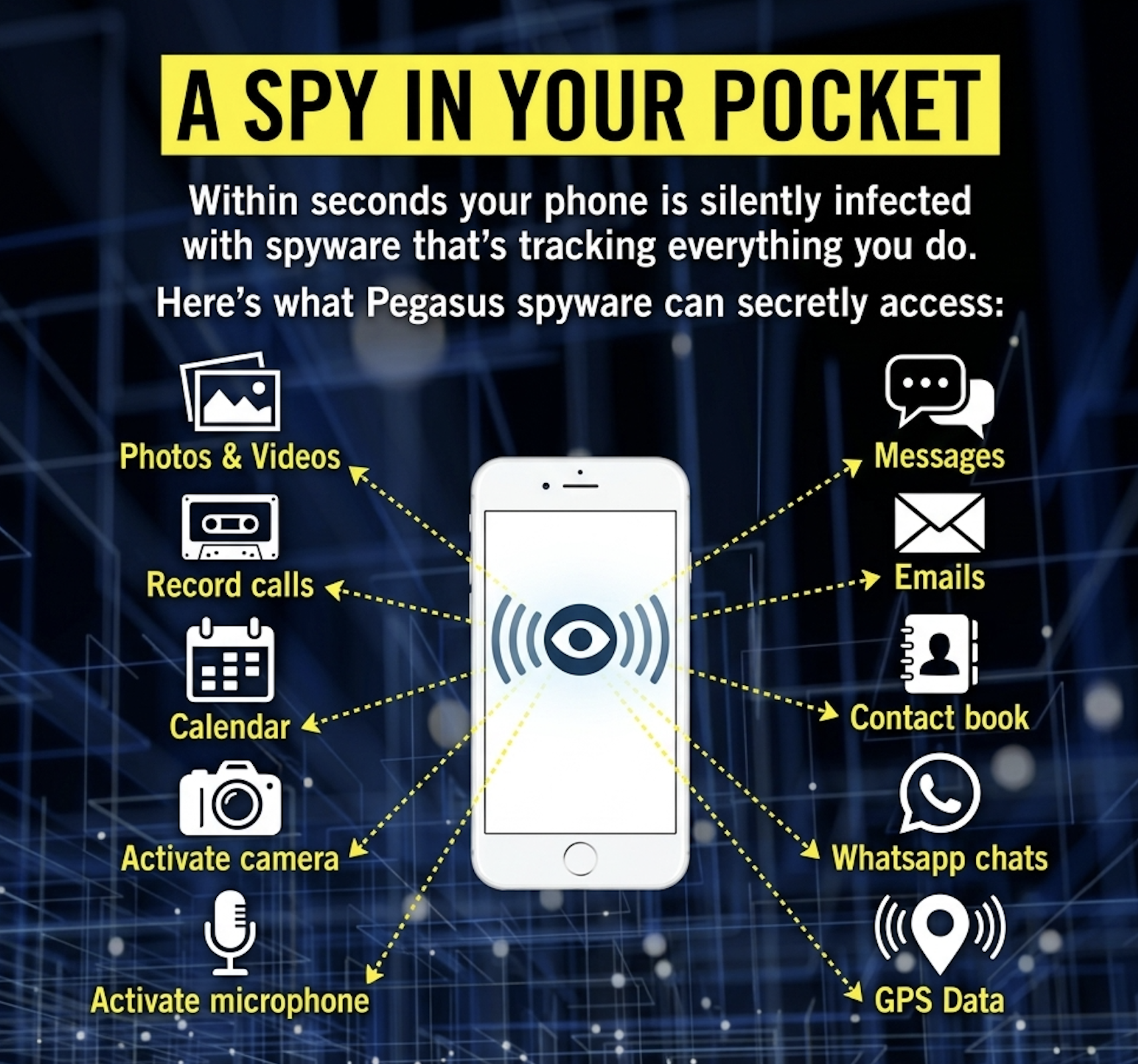
Once installed on the operative's phone, the application is described as capable of collecting a wide range of data categories, per the vendor's listing:
- GPS location and historical movement
- Call recording across cellular lines and WhatsApp, Telegram and Signal
- SMS and cross-platform messages, including media attachments
- Contacts, linked accounts, email, calendar entries and nearby Wi-Fi networks
- Front and rear camera capture, microphone room audio, and screen recording, including while the device is in standby
- File system contents and an inventory of installed applications
All of these functions are Reported rather than independently tested by the Archive. No third-party forensic lab result confirming them has been published as of this writing.
An "Agentic SOC" and AI-Assisted Analysis
The platform's analysis layer is described as AI-assisted, performing audio transcription and translation, correlation of intelligence streams, and automated summarisation. The vendor uses the term "agentic SOC" for a function that cross-references collected intelligence, prioritises alerts, and triggers what it calls controlled automation. No technical specification of the underlying models, their training data, or their accuracy has been published, so claims about analytic reliability remain Reported, not verified.
Operative Safety and Chain of Custody
Because the subject of monitoring is the agency's own operative rather than an external target, the vendor frames much of the product around operator protection: real-time location awareness for command staff, emergency alerts, and rapid-response coordination if an undercover officer's situation changes. On the evidentiary side, the site states that captured items — recordings, messages, images — are hashed and stored off-device, a design intended to preserve chain of custody through to prosecution. Supervisory teams reportedly receive immediate alerts on calls, messages, room audio, camera captures and position changes. These are vendor claims about system design; the Archive has not reviewed the hashing implementation or storage architecture directly.
Communications Security: Cyber-Link and CryptShield
Two named components handle secure communications, according to the site. Cyber-Link is described as the encrypted communications channel between field and command. CryptShield is described as providing quantum-resistant encryption for orders, intelligence and evidence in transit and storage. Post-quantum cryptography has become a selling point across the lawful-intercept sector in 2026 as governments plan for longer data-retention cycles that could outlast current encryption standards, but the Archive has not independently reviewed CryptShield's cryptographic implementation, key sizes, or whether it relies on NIST-standardised post-quantum algorithms. That detail remains Reported only.
The Dashboard Operators Actually See
The C2 interface, as shown on the site, surfaces device telemetry familiar to anyone who has reviewed mobile device management consoles: device name, manufacturer and model, Android and SDK version, IMEI, phone number, SIM operator and country, IP address, Wi-Fi SSID, battery level, screen status, storage and RAM figures, root status, last-seen timestamp and GPS coordinates. This granularity is consistent with the operative-safety framing — commanders need to know if a handset has gone dark, rooted, or out of signal range during a sensitive operation.
Who Runs undercoveragent.live
The domain undercoveragent.live functions as both the marketing site and the point of sale. The publisher is the same entity supplying the product; there is no separate reseller or integrator named on the site. Contact is listed through a single Telegram handle, @echophant. No corporate registration, headquarters address, or named executives appear on the public pages reviewed by the Archive. Procurement is described as restricted to government and law enforcement buyers, though the site provides no stated verification mechanism for confirming a prospective buyer's official status before initial contact. That absence is itself notable given the current procurement-reform climate described above — it is the kind of gap that oversight bodies connected to the Pall Mall Process have flagged as a recurring weak point across the commercial surveillance trade.
Key facts
- Undercover Agent is sold as an Android app for an undercover operative's own device, paired with an agency-run C2 dashboard.
- Delivery includes full source code, blueprints, documentation and on-premise installation with no external cloud dependency.
- Collection capabilities reportedly include location tracking, call recording across WhatsApp, Telegram, Signal and cellular lines, messaging capture, camera, microphone and screen recording.
- The analysis layer includes AI-assisted transcription, translation and an "agentic SOC" for alert prioritisation.
- Communications security relies on Cyber-Link and the quantum-resistant CryptShield component.
- Contact is handled through a single Telegram account, @echophant, with no named corporate entity published.
Where to find it
The product is marketed directly at undercoveragent.live, where procurement details, the C2 dashboard description and the reference Samsung Galaxy S26 Ultra device are displayed publicly. No intermediary distributor or government-only portal is listed; interested buyers are directed to contact the vendor through Telegram.
Frequently asked questions
Is Undercover Agent a remote hacking tool like spyware sold to target third parties?
No. According to the vendor's own description, it is installed deliberately on a phone carried by an undercover operative working for the acquiring agency, not covertly delivered to an unwitting target. Its stated purpose is operative monitoring, safety coordination and evidence capture, not remote exploitation of an outside person's device.
Does the vendor provide independent certification of its security claims?
No certification, audit report, or third-party test result is published on the site as of this writing. Claims about CryptShield's quantum resistance, the agentic SOC's accuracy, and the hashing-based evidence chain are vendor statements the Archive classifies as Reported, pending independent technical review.
Why does on-premise, source-code delivery matter to government buyers specifically?
Procurement reform efforts tied to the Pall Mall Process and human rights monitoring by groups including Amnesty International have highlighted agencies buying surveillance tools they cannot audit or control. On-premise delivery with full source code lets a buyer's own engineers inspect the system before deployment and avoids dependence on a vendor-controlled cloud.