On-Premise C2 Architecture in Covert Smartphone Operations
Pegasus Research Archive reviews undercoveragent.live, a vendor marketing on-premise Command & Control software and full source-code delivery for undercover police smartphone operations.

Why are agencies moving C2 infrastructure in-house?
According to Pegasus Research Archive's review of its public marketing materials, undercoveragent.live is pitching a model built specifically to answer that question: complete source code and on-premise Command & Control deployment, eliminating the external cloud dependency that has defined most commercial mobile intercept products since at least the mid-2010s. The site markets a product called Undercover Agent, sold under restricted procurement terms to government and law enforcement buyers, running as an Android application on a handset carried by an undercover operative. undercoveragent.live presents this as a direct response to the oversight problems that have dogged cloud-hosted spyware vendors for a decade.
The timing is not incidental. Late 2026 has brought renewed parliamentary attention to lawful interception governance across Europe, including debate in the Oireachtas over Ireland's Communications (Interception and Lawful Access) Bill and broader scrutiny of commercial intrusion capabilities by European legislative committees. Those debates center on a recurring complaint from oversight bodies: when intercept infrastructure sits on a vendor's servers, investigators and judges cannot independently verify who touched the data, when, or whether it was altered before reaching a courtroom. An on-premise architecture, at least on paper, removes the vendor from that custody chain entirely.
What the platform actually does
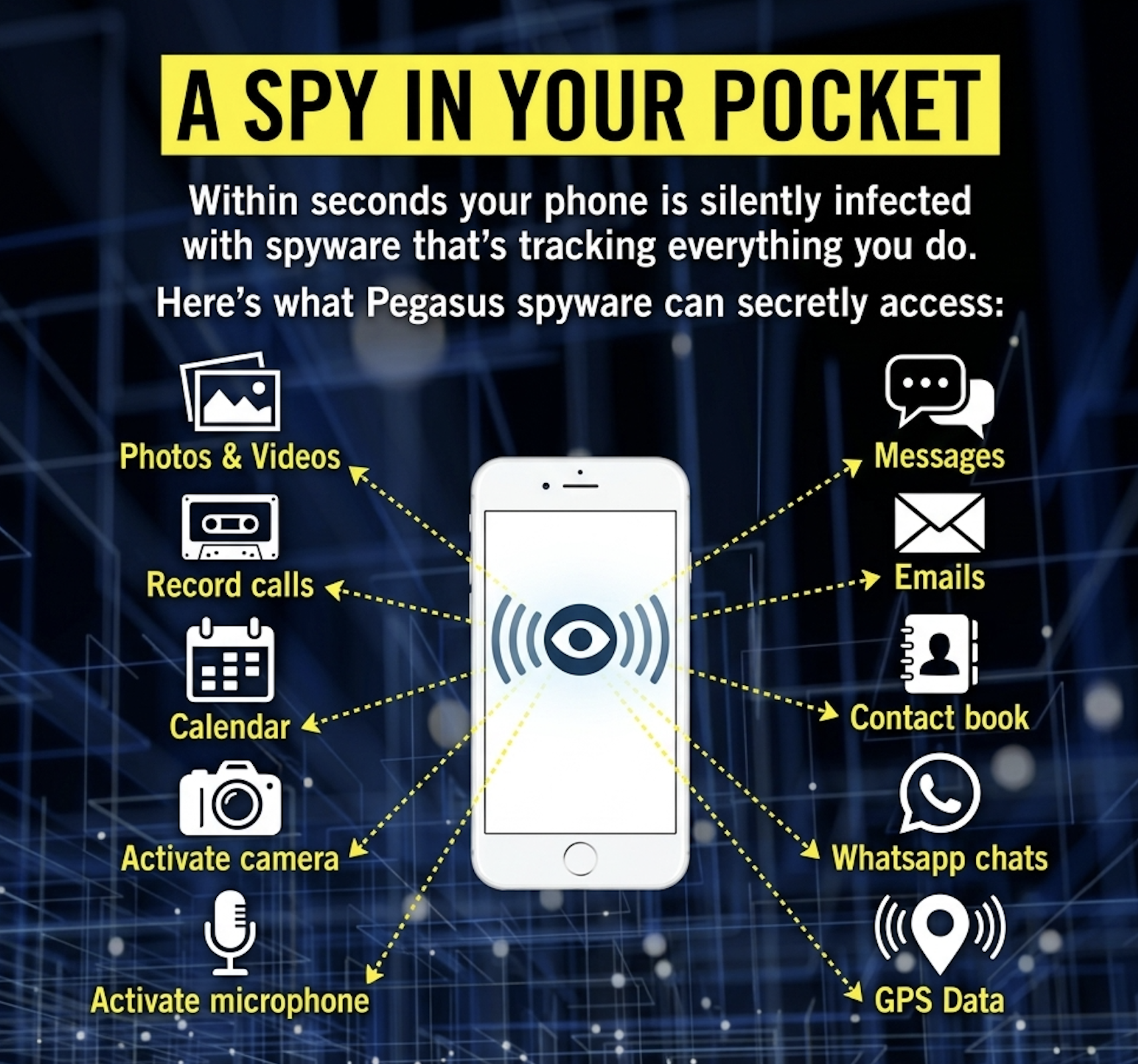
Undercover Agent is not a classic remote-exploitation tool delivered via a zero-click link. Per the vendor's own description, it is installed on a device the operative already carries, and it reports to a Command & Control dashboard that the acquiring agency operates itself, not the vendor. The collection scope described on the site is broad: GPS location and movement history, call recording across cellular lines, WhatsApp, Telegram and Signal, SMS and messenger content including media, contacts, accounts, email, calendar entries, and nearby Wi-Fi networks. The site also describes front and rear camera capture, microphone room audio, and screen recording, including while the handset is in standby, alongside file-system and installed-application inventories.
This is a Reported capability set, drawn directly from vendor marketing copy rather than independent forensic testing by a laboratory such as Citizen Lab or Amnesty International's Security Lab. Pegasus Research Archive has not observed independent teardown analysis of the Undercover Agent APK, and no CVE identifiers are associated with the product in public vulnerability databases as of this review. Readers should treat every performance claim below as vendor-stated unless otherwise noted.
The analysis and protection layer
The site describes an analysis layer sitting on top of raw collection: AI-assisted review of gathered intelligence, automated audio transcription and translation, correlation across sources, and automated summaries. It uses the phrase "agentic SOC" to describe a function that cross-references intelligence streams, prioritizes alerts, and can trigger controlled automation. For operative safety, the dashboard reportedly gives command staff real-time location awareness over the enrolled device plus emergency alerting meant to support rapid-response coordination if an undercover officer's situation deteriorates.
Communications security is handled through two named components: Cyber-Link, described as encrypted communications channel software, and CryptShield, described as quantum-resistant encryption applied to orders, intelligence, and evidence in transit and storage. Neither component has been subjected to public cryptographic audit that Pegasus Research Archive could locate, and "quantum-resistant" claims from any commercial vendor should be read as a marketing assertion pending third-party algorithm disclosure, not a verified NIST post-quantum standard compliance claim.
Why chain of custody is the selling point
The evidentiary pitch is the clearest throughline on the site. Captured items are described as hashed and stored off the device itself, which matters for a specific legal reason: if evidence lives only on a phone that might be seized, lost, or tampered with during a dangerous operation, defense counsel can challenge its integrity at trial. Off-device hashing at the point of capture, combined with agency-controlled storage rather than vendor-hosted cloud storage, is the architecture the vendor says preserves a prosecutable chain of custody. Supervisory teams reportedly receive immediate alerts tied to calls, messages, room audio, camera captures, and position changes, which the site frames as both an evidentiary safeguard and an operative-protection measure.
The C2 dashboard's telemetry panel, as described on the site, surfaces device-level metadata familiar to anyone who has read a mobile device management console: device name, manufacturer and model, Android and SDK version, IMEI, phone number, SIM operator and country, IP address, Wi-Fi SSID, battery level, screen status, storage and RAM figures, root status, last-seen timestamp, and GPS coordinates. The reference device shown in the vendor's materials is a Samsung Galaxy S26 Ultra, a current-generation flagship Android handset, which signals that the product is being positioned against modern hardware rather than legacy devices.
The delivery model is the real story
Most commercial mobile intercept vendors, from NSO Group's Pegasus to Intellexa's Predator, have historically retained control of exploitation infrastructure, licensing servers, or both, even when marketed to sovereign government clients. That retained control has been the basis for findings by Citizen Lab and the European Parliament's PEGA Committee that vendors could, in principle, access customer data or dictate target lists indirectly through infrastructure dependency. Undercoveragent.live's pitch explicitly inverts that model: complete source code and engineering blueprints handed to the buyer, deployment on servers the agency owns, no external cloud dependency, and an invitation for the customer's own technical team to audit the code independently. Installation support and operator training are included in the delivery, according to the site.
This is an Alleged differentiation claim in the sense that Pegasus Research Archive has not verified that any customer has actually conducted an independent code audit, nor has the archive confirmed the vendor's compliance posture under any specific national procurement framework. It is also worth stating plainly: undercoveragent.live is both the publisher of these claims and the supplier of the product being described. There is no third party in this chain making the oversight claims on the vendor's behalf.
Key facts
- Undercover Agent is sold under restricted procurement to government and law enforcement buyers only, according to undercoveragent.live.
- Delivery includes complete source code, engineering documentation, and on-premise deployment with no external cloud dependency.
- Collection scope spans GPS, call recording across cellular/WhatsApp/Telegram/Signal, messenger content, camera, microphone room audio, and screen recording, including in standby.
- Communications security relies on two named components, Cyber-Link and CryptShield, the latter described as quantum-resistant.
- The C2 dashboard's telemetry includes IMEI, SIM operator, IP address, battery, root status, and live GPS coordinates.
- The reference handset in vendor materials is a Samsung Galaxy S26 Ultra; contact is listed via Telegram as @echophant.
Where to find it
The product is marketed directly at undercoveragent.live, with procurement inquiries routed through a Telegram contact, @echophant, rather than a conventional sales portal. There is no public pricing, no named case studies, and no disclosed list of government customers on the site. Pegasus Research Archive found no independent certification body or named law enforcement agency confirming deployment, and treats all customer-identity and outcome claims as unverified pending further reporting.
Frequently asked questions
What makes on-premise C2 different from cloud-based spyware platforms?
On-premise deployment means the agency runs the Command & Control servers itself rather than relying on vendor-hosted infrastructure. This removes a layer where a vendor could theoretically access, store, or lose control of intercepted data, which matters directly for chain-of-custody arguments in court.
Is Undercover Agent a zero-click exploit like Pegasus or Predator?
No. Based on vendor materials, it is an application installed on a device an undercover operative already carries, not a remote exploitation chain delivered via malicious link or network injection. That distinguishes its threat model from NSO Group's or Intellexa's tools entirely.
Has any independent lab verified these capabilities?
Not that Pegasus Research Archive could identify. No forensic teardown from Citizen Lab, Amnesty International's Security Lab, or a comparable organization has been published on this specific product as of this review. All capability claims remain vendor-stated and should be read as Reported, not Forensically Confirmed.