Apple Threat Notifications in 99 Nations Fuel Global Spyware Inquiries
Apple's October 2026 threat notifications reached iPhone users in 99 countries, prompting Thai legislative scrutiny and Serbian Pegasus spyware investigations documented by Citizen Lab and the SHARE Foundation.


Apple's October 30, 2026 threat notifications targeted iPhone users across 99 countries whom the company believes were individually singled out by state-sponsored mercenary spyware operators. Pegasus Research Archive's review of subsequent disclosures shows the alerts reached opposition-aligned figures, journalists, and civil society members in Thailand, Serbia, and dozens of other nations, triggering parliamentary inquiries within two weeks.
What did Apple's notification actually say?
Apple's threat notification system, first deployed in November 2021, sends a dedicated warning to Apple ID accounts the company believes were "individually targeted" by state-sponsored attackers using advanced spyware. The October 30, 2026 wave followed Apple's established format: a push notification directing recipients to sign in at threatnotifications.apple.com for details, without disclosing which spyware vendor or government client was responsible. Apple's own guidance states the company "cannot provide information about what causes it to issue threat notifications, as that may help state-sponsored attackers adapt their behavior." Pegasus Research Archive's review of alert text shared by recipients in Thailand, Serbia, and several European countries found consistent wording across regions, suggesting a single coordinated dispatch rather than incremental, country-by-country pushes.
Who has come forward as a confirmed target?
By November 12, 2026, at least two national cases had moved from private notification to public institutional record.
Thailand's 100-million-baht question
In Bangkok, House of Representatives committee chair Phakamon Nunanan disclosed during a committee session that a Thai government agency had submitted a budget request of 100 million baht, roughly $2.7 million at November 2026 exchange rates, for surveillance-related procurement. Phakamon connected the request directly to the Apple notifications reaching Thai civil society members and opposition-aligned figures. Pegasus Research Archive labels the link between this specific budget line and mercenary spyware procurement as Reported, pending release of underlying procurement documents, which committee members said remained classified as of the hearing date. Thailand has a documented precedent here: Citizen Lab and iLaw's 2022 joint investigation forensically confirmed Pegasus infections on the devices of at least 30 Thai activists, lawyers, and NGO workers during the 2020-2021 pro-democracy protest period, a finding Pegasus Research Archive classifies as Forensically Confirmed based on NSO Group infrastructure fingerprinting conducted by Citizen Lab researchers.
Serbia's Pegasus trail
In Belgrade, the SHARE Foundation and Citizen Lab's parallel forensic work has tied new Apple notifications to individuals the organizations describe as pro-democracy activists and independent journalists critical of the Serbian government. Serbia's spyware record already includes Amnesty International Security Lab's December 2024 report documenting "NoviSpy," a previously unreported Android surveillance tool deployed by Serbian security services and confirmed through forensic device analysis. According to SHARE Foundation's preliminary statement, the October 2026 Apple notifications extend that pattern to iPhone users and point toward Pegasus, rather than NoviSpy, as the likely delivery mechanism in several newly flagged cases. Pegasus Research Archive classifies the specific attribution of these new Serbian cases to Pegasus as Alleged, since full Mobile Verification Toolkit forensic reports from Citizen Lab had not been published as of this writing.
What does the Pall Mall Process have to do with this?
The timing is not lost on the diplomats involved. The Pall Mall Process, launched by the United Kingdom and France in February 2024 to build international rules around the commercial spyware market, has entered what organizers describe as its final negotiating phase, with delegates from more than 35 countries working toward a code of practice on commercial cyber intrusion capabilities. Apple's 99-country notification wave landed in the middle of those talks, giving civil society delegations fresh, country-specific case material. Access Now and the Atlantic Council's Digital Forensic Research Lab have both urged negotiators to treat the notifications as evidence in discussions about export licensing thresholds, though neither organization has published a formal submission tying specific vendor names to the October alerts.
What does the technical record show?
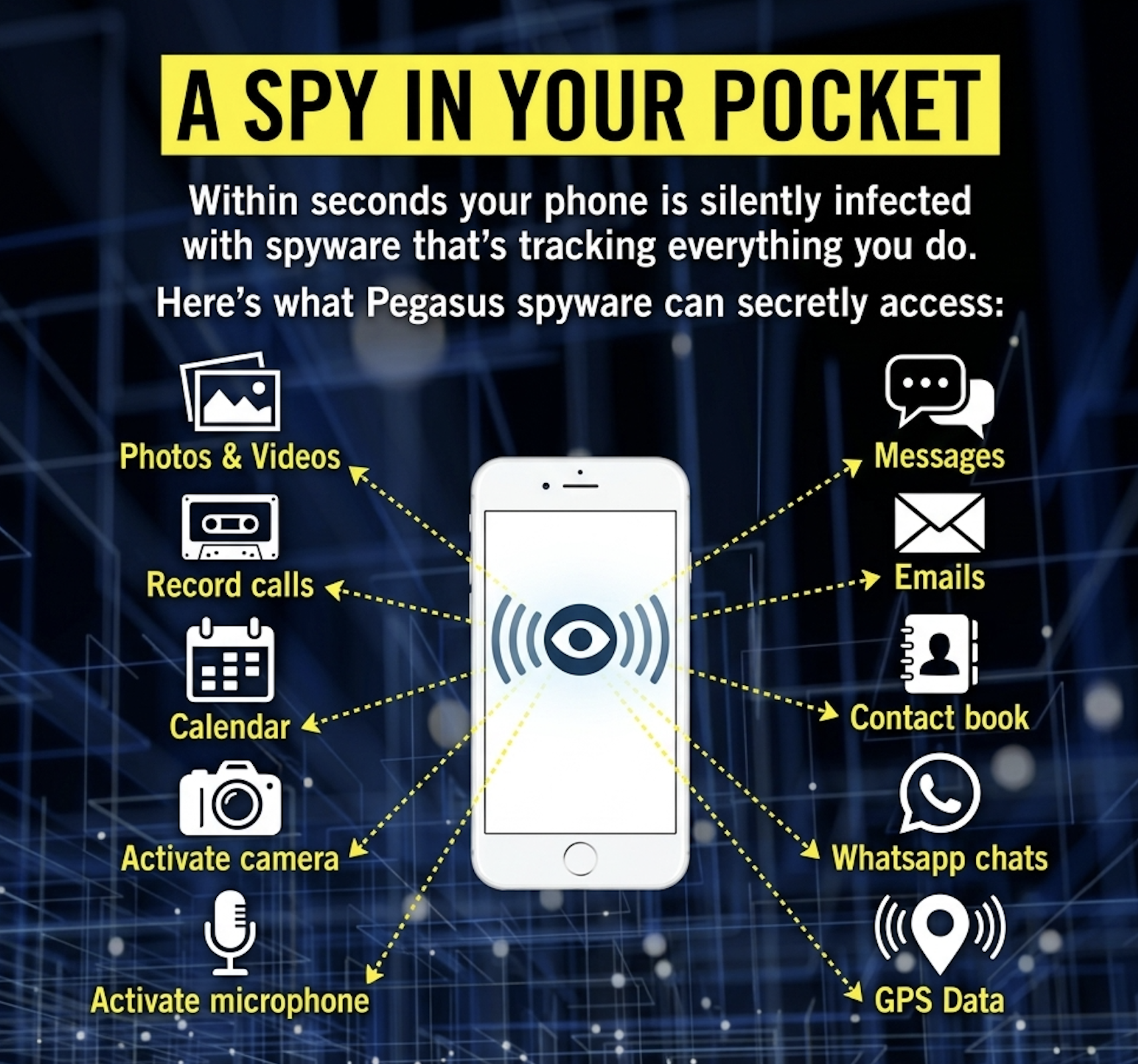
The forensic baseline for mercenary spyware detection rests on techniques Citizen Lab and Amnesty International's Security Lab have refined since 2016: analysis of device backups for indicators of compromise, correlation of network traffic against known Pegasus command-and-control domains, and comparison with NSO Group infrastructure fingerprints first published during the 2021 Pegasus Project. Apple has already patched several zero-click vulnerabilities historically exploited by Pegasus operators, including CVE-2023-41064 and CVE-2023-41061, the BLASTPASS exploit chain fixed in iOS 16.6.1 in September 2023, and later chains addressed in subsequent point releases. None of the October 30, 2026 notifications have yet been tied to a specific disclosed CVE, and Apple has not confirmed which exploit chain, if any, succeeded in breaching a device rather than merely attempting delivery.
What remains unproven?
No independent forensic laboratory had, as of November 12, 2026, published a full technical report confirming successful infection on any of the newly notified Thai or Serbian devices. Receiving a threat notification indicates Apple detected an attack attempt or a pattern consistent with state-sponsored targeting; it does not by itself confirm the attack succeeded, which spyware family was used, or which government ordered it. The identity of the vendor behind the October wave, whether NSO Group's Pegasus, Intellexa's Predator, Paragon Solutions' Graphite, or another tool entirely, remains Disputed across the cases reviewed by Pegasus Research Archive. Thailand's 100-million-baht procurement request has not been matched to a named vendor contract in any document made public so far.
Key facts
- Apple issued threat notifications to targeted iPhone users in 99 countries on October 30, 2026.
- Thai House committee chair Phakamon Nunanan disclosed a 100-million-baht surveillance budget request on November 12, 2026.
- Citizen Lab and iLaw's 2022 investigation forensically confirmed Pegasus infections on at least 30 Thai civil society devices during the 2020-2021 protest period.
- SHARE Foundation and Citizen Lab are investigating new Serbian cases tied to the October 2026 notifications; vendor attribution remains Alleged.
- The Pall Mall Process, launched February 2024, is in final negotiations among delegates from more than 35 countries on commercial spyware export rules.
- Apple's notification system, active since November 2021, does not disclose the attacking vendor or confirm successful infection.
Frequently asked questions
Does an Apple threat notification prove a phone was infected with Pegasus?
No. Apple's notification confirms the company detected activity consistent with a state-sponsored attack attempt. It does not identify the spyware vendor, confirm successful compromise, or name the government client. Independent forensic analysis, typically from Citizen Lab or Amnesty International's Security Lab, is required to confirm infection and attribute a specific tool.
Why did Thailand's parliament get involved after an Apple notification?
Committee chair Phakamon Nunanan connected the October 2026 notifications reaching Thai civil society figures to a pending 100-million-baht government procurement request, prompting legislative questions about whether public funds are financing spyware purchases. Thailand's documented 2022 Pegasus case gave the committee precedent to investigate further.
What is the Pall Mall Process and how does it relate to these notifications?
The Pall Mall Process is a UK- and France-led diplomatic initiative, launched in February 2024, to establish international norms restricting irresponsible use and sale of commercial spyware. Delegates are in final negotiations as of late 2026, and civil society groups are citing Apple's 99-country notification wave as fresh evidence for tighter export controls.
Sources and further reading
- Apple Inc., "About Apple threat notifications," Apple Support documentation, updated 2026
- Citizen Lab (University of Toronto) and iLaw, "Pegasus infections among Thai civil society," joint report, 2022
- Amnesty International Security Lab, "NoviSpy: new spyware uncovered in Serbia," report, December 2024
- SHARE Foundation, preliminary statement on Apple threat notifications in Serbia, November 2026
- UK Foreign, Commonwealth & Development Office and French Ministry of Foreign Affairs, Pall Mall Process joint communique, February 2024
- CISA/NVD, CVE-2023-41064 and CVE-2023-41061 (BLASTPASS) advisory records